



FEEDBACK
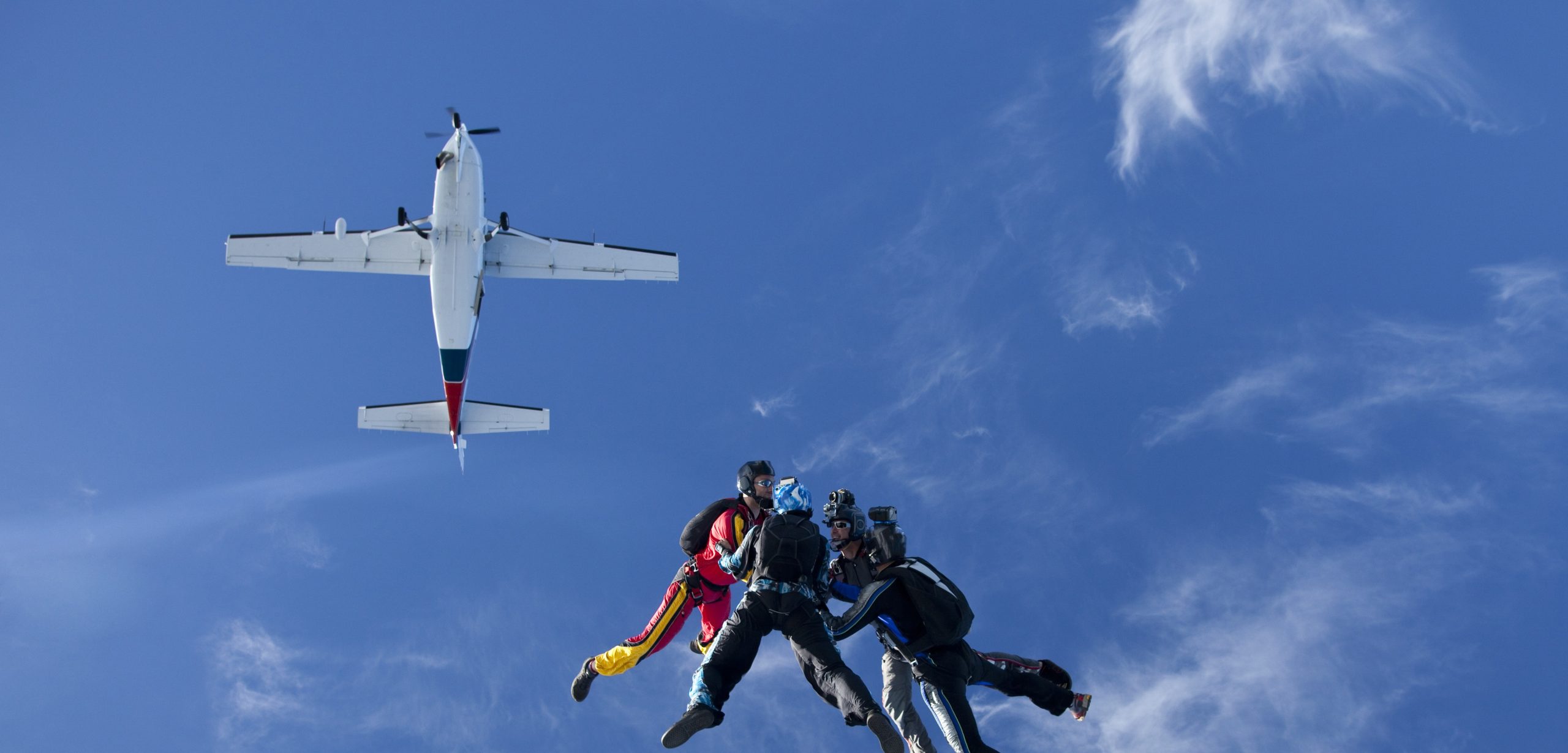
Parachutes, planes and passengers
Welcome Rich Harrison
Welcome to this latest edition of FEEDBACK for the General Aviation community which features a variety of articles involving planes, parachute jumping (skydiving to be more precise) and familiarisation flying with passengers. Since the last edition of FEEDBACK was published CHIRP has a new Director Aviation in the form of Rich Harrison, who joined the team in April 2026. Rich’s biography is provided below for FEEDBACK readers to learn more about his aviation background and it can also be found on the CHIRP website alongside other team members – Team – CHIRP.
Rich has joined CHIRP as Director Aviation fresh from a full aviation career as a pilot in the Royal Navy’s Fleet Air Arm. Rich joined the Royal Navy in 1994 and over his military career has flown the T67M Firefly, Gazelle HT2 and Sea King Mk4 aircraft. He has also spent time off-duty gliding with the Royal Navy Gliding Club achieving solo standard. As a Sea King pilot he deployed to numerous operational theatres on land and at sea, accumulating 2500 flying hours and undertaking warfare-related instructional duties.
In the later stages of his naval career Rich specialised in aviation safety and led the management and oversight of the Air Safety Management System for the Fleet Air Arm (2020-2022) and then undertook a similar role for the Joint Aviation Command, Defence’s HQ for UK Battlefield helicopters and drones, between 2022-2026. In this last position Rich and his safety team interacted routinely with the UK FSC, UKAB and CAA on various safety matters. He also managed military aviation safety reporting systems (both open and confidential reporting) and Human Factors safety training for Army, RAF and Navy personnel.
Rich is excited to have the opportunity to continue specialising in Aviation Safety and Human Factors, delivering CHIRP’s commitment in enabling any person involved in professional or recreational aviation activity to confidentially report safety concerns.
During the last six months as interim GAPM I have learned a lot about reporting culture and attitudes to safety across various sections of the GA community and was pleased to meet many of you along the way. I am delighted that Mike O’Donoghue CBE FRAeS joins CHIRP from GASCo to take over as GA Programme Manager, which allows me to return to my roles as CHIRP Air Transport and Advanced Air Mobility Programme Manager.
William (Bill) Dean,
Interim GA Programme Manager
Share with CHIRP
Have you had an incident or a near miss? Could CHIRP help or offer advice on a safety concern? Perhaps you’ve experienced or observed something with a human factors angle that you think the wider aviation community could learn from. Why not share it with CHIRP? Confidentiality, whereby only CHIRP and the reporter are aware of names and employer / organisations involved, promotes trust in the reporting and sharing of experiences. Every report helps raise awareness of safety issues, highlights emerging trends and shares valuable lessons with others.
“You report it, we help sort it.”
Reporting to CHIRP is simple and quick using either our website portal or the CHIRP App (scan the relevant QR code or search for ‘CHIRP Aviation’ but watch out for the birdsong apps!). The portal presents a series of fields for you to complete, but not every field is mandatory – just tell us as much as you can. The more detail you provide, the more effectively we can help.
Although you’ll be asked for an email address to access the system (to screen out bots and spam), your personal information is held securely within CHIRP’s independent systems and is never shared outside the organisation. Importantly, nothing that could identify a reporter is included in any report we progress or publish. We liaise with you at every stage and no information is passed on without your express consent.
So rather than ‘fly and forget’, please consider working with CHIRP to help make the skies safer for everyone. However, it’s important to note that reporting to CHIRP is not a substitute for submitting a Mandatory Occurrence Report (MOR) when required, for example, when there has been a significant risk to safety, or an event that could have endangered the aircraft, its occupants, or others. MORs should be submitted via the CAA’s ECCAIRS 2 portal.

The fact that you’re reading this means you already know about CHIRP General Aviation FEEDBACK? In case you don’t receive our emails with links to new editions, as well as our sister Air Transport, Drone/UAS and Cabin Crew versions, please use the subscribe option, which can be found at the bottom of our website https://chirp.co.uk/aviation/subscribe/. Through this link you will soon have the option to request paper copies of GA FEEDBACK too. Alternatively, email us at mail@chirp.co.uk with your name, address and number of copies required, and we’ll add you to our mailing list.

Pooleys have kindly agreed to support CHIRP’s fund-raising activities by allocating us a discount code on their website shop. Enter the code ‘Chirp’ (case sensitive) at the appropriate point at the payment stage to get 5% discount and generate some commission for CHIRP. Sadly, this doesn’t apply to the purchase of Bose headsets, but everything else qualifies. If you do use Pooleys for your purchases, or know other people who do, please do share the code. The more the code is circulated, the more it is used and the greater the commission generated to help CHIRP build its resources to do more.

We have recently received correspondence from readers of a previous edition of GA FEEDBACK responding to a banner we included in Edition 107 for the MET Office MAVIS App. As a reminder, MAVIS (Met Office Aeronautical Visualisation Service) is a new, integrated and cloud-based aviation weather platform launched in March 2026 to replace legacy systems with a single interface. It provides “comprehensive, real-time meteorological data—such as METARs, TAFs, and interactive, customizable map layers—tailored for users ranging from general aviation pilots to major airlines and spaceport operators”.
One reader’s feedback to CHIRP about MAVIS made the following points (summarised by CHIRP):
– An overarching concern that MAVIS is unusable.
– Very poor information portrayed by the new graphics.
– Wording too small to be read.
– Screens are unstable.
– Difficulty in moving to the next screen and having to shut down and re-open from scratch.
– Some of the old screens (e.g. satellite images, cloud fog & precipitation) are no longer available.
– Why is ‘sea state’ needed?
– Difficulty in navigating the system in a timely manner, particularly while flying.
– Cloud cover, temperature and wind charts no longer give useable information.
– Scrolling the timeline is very awkward.
– Reading METARs and TAFs is not intuitive or user friendly.
– The new system isn’t complete and by no means useable! I now have to use other weather platforms – the old system was great, what was the need for change and such massive sub-quality information?
CHIRP passed on this reader’s feedback to the MET OFFICE, and we received the following reply:
“Thank you for taking the time to review the new MAVIS system. Your comments have been noted and shared with the Met Office’s MAVIS product team.
The technical infrastructure that the previous Aviation Briefing Service (ABS) platform was managed on, was at end of life. The platform carried several security and performance issues that meant that it was no longer effective, safe or efficient to keep running for a meteorological service that must have a high-level of availability for regulatory aviation safety reasons. The Met Office, in accordance with its obligations to the Civil Aviation Authority are responsible for providing a reliable, safe and effective pre-flight weather briefing service for all aviation users, and MAVIS has been developed to meet these requirements across all UK aviation users.
Your feedback appears to centre on the following 2 themes, which are explored more thoroughly below:
- Usability
- Content
- Usability
Your feedback highlights a concern about the presentation of the information on MAVIS, and in particular the small wording and cluttered feel. The Met Office has received a variety of feedback around the text size of reports and aerodromes names on MAVIS, and we appreciate this can be challenging. Currently, the text size can be altered via your browser’s system settings by changing the zoom view (control + mouse wheel and scroll ‘up’, or in the browser settings zoom can be enabled). Alternatively on a phone/tablet use the text size function to manually alter the text size. We can advise that future updates to MAVIS are being planned for release, delivering a range of additional features. Whilst we cannot put a definitive timeframe on each future release, we can advise that one of these is planned to include the ability within MAVIS to control text or icon size. In terms of navigation, it should not be necessary to close down and re-open MAVIS on account of it being cluttered. For example, you may wish to be aware that you can close briefing products such as the F215 by clicking in the ‘cross’ in the top left hand corner.
We note your comment concerning the readability of TAFs and METARs. Based on previous feedback on the aerodrome list and TAFs and METARs display, we can advise that this part of the menu panel has recently been made wider (you can now expand it to half the screen in a browser). The TAF and METAR text now wrap around within that panel.
Your correspondence refers to scrolling through a timeline as being awkward to use. During the development of MAVIS one recurring theme from ABS users was that there were not enough timesteps in the weather map layers to provide a meaningful trend of the weather over a period of time. For example, timesteps that updated every 3 or 6 hours were considered too coarse. With MAVIS, the Met Office has been able to utilise more data and therefore incorporate additional timesteps which are intended to address this user feedback. These additional timesteps have broadly been welcomed by users, but we do appreciate this has resulted in more scrolling. We will continue to review the timesteps available for each layer to ensure we are striking the right balance between having more information available and maintaining a good user experience. To assist with navigation, do look for the >> symbol on the timeline. This takes you 24 hours ahead, to help you quickly navigate forward in time to the day of interest. Please feel free to let us know if you have any other challenges with this feature.
Your feedback highlights the number of clicks needed to navigate around MAVIS. There has been feedback from a range of users about the number of clicks it can take to navigate to specific forecast products. The Met Office is driven to ensure that MAVIS is as easy to navigate as possible. You will appreciate that changing functionality in a service needs to be carefully considered to ensure that the widest number of users have a positive experience of the change. You may already be aware of the feature that allows users to ‘pin’ favourite weather layers and products, so that the content you use most often remains easily accessible at the top of the maps and reports panels.
- Content
The Map layers that have been included in the initial release of MAVIS have focussed on the requirements mandated by the CAA. As a result of similar feedback received by the Met Office regarding ‘combined’ map layers (i.e. ”cloud fog and precipitation”) we are exploring ways to include this information in a way that maintains a clear view of the forecast weather conditions and upholds accessibility guidelines, whilst not presenting a cluttered map view.
Your feedback also highlights that the cloud cover, temperature and wind layers may no longer provide usable information. These products are a like for like replacement to what was available on ABS, and it would be useful to understand more about this concern.
To address your comment on “why do we need ”sea-state’?”, it should be recognised that MAVIS is required to satisfy a wide range of UK airspace users. This means that some features or map layers must be available even if it is not explicitly something used by yourself. For example, the sea state map layer is very necessary information for offshore and Search & Rescue. As we continue to add more functionalities into MAVIS, we will be considering ways to allow individual users to further customise the service to meet their specific requirements. As mentioned earlier, to aid speed of navigation, it is possible to pin your preferred map layers, reports and sites, so that these take primary position in the menu when planning your flights.
We appreciate that you have already been using MAVIS, and can bring to your attention the following resources that may be of use especially as the Met Office are keeping this up to date as new features are added:
- The User Guide: https://docs.mavis.metoffice.gov.uk
- A recording of key features https://www.metoffice.gov.uk/services/transport/aviation/regulated/mavis/resources (second video)
I should like to reassure that MAVIS has been tested extensively with a variety of users and this engagement continues today. We really welcome your feedback, as this helps ensure that future developments to MAVIS will be influenced by such feedback. We do review feedback that comes from users via our feedback form as this influences our prioritisation process. Please do not hesitate to share any new feedback you have via MAVIS User Feedback link provided.
Kind regards
The Met Office MAVIS Team”
William Dean
Air Transport Programme Manager
Contact:


 Share
Share
“Stop pushing! – I have control”
As this edition of GAFB is my last as interim CHIRP GA Programme Manager, I thought I’d use the opportunity to share an experience of my own when flying with a paying passenger in a tandem seat historic fighter aircraft.
The opportunity to experience what it’s like to fly in a WWII fighter has always been a popular aspiration for many and in response to increasing demand the CAA introduced the Safety Standards Acknowledgement and Consent (SSAC) framework in 2014, following proposals captured in CAA publication “Let There be Flight.” As a result, Harvard, Mustang, and Spitfire flights, in particular, have become increasingly available allowing qualified pilots, as well as the general public, to experience these iconic historic aircraft whilst airborne. A truly wonderful, and unforgettable experience.
On this occasion, I was the pilot of a two-seat Spitfire operated by a company operating SSAC flights. SSAC pilots often fly multiple trips a day and my passenger during the flight in question was my third of the day. The first two had been qualified pilots, one ex-airline, the other experienced GA pilot, and therefore as much as possible of their individual 20-minute trips had been flown by them, such as during straight and level manoeuvring, in order to give them a feel for the aircraft in flight. The third trip was different, this time with an elderly passenger who was not a qualified pilot, and their motivation to fly in a Spitfire was based, I was told, on a family member having flown Spitfires during WWII.
This third sortie was planned in the same general airspace, due to favourable weather conditions, and the take off and departure, including the all-important timings, went like clockwork. I had briefed the passenger that at some point during the sortie, when straight and level, I would allow them to take hold of the control column, with me still at the controls, and feel the sensations of flying a Spitfire in flight, and as previously mentioned, something I had done many times before and without incident. As one would expect, before this happens the passenger is briefed thoroughly about the need to place only their right hand on the control column and to use very small movements. They are specifically briefed not to touch the throttle or the rudder pedals. This briefing is particularly important because, without stating the obvious, the Spitfire two-seater is a tandem aircraft, as opposed to a side-by-side configuration, and as such, the front seat instructor pilot is unable to see what the passenger is doing in the rear cockpit at any point after strapping in. Read on……
When it came for the passenger to hold lightly on to the control column in level flight, I made sure I was in uncrowded airspace, and weather conditions permitted a good lookout. This is when the unexpected happened and I was jolted out of the relaxed and comfortable state I was in. Almost immediately after instructing the passenger to place their right hand gently on the control column, as we had briefed only minutes before, I felt it move forwards rapidly with a sudden push, and even though I had my hand firmly in place on the control column too, I could not prevent us from being bunted violently forward towards to ground!
I instinctively and instantaneously pulled back on the control column and shouted – “Stop pushing! – I have control”. Having regained my composure after the inevitable ‘startle’ effect, we returned to the airfield in a much more leisurely manner, and I was pleased to put the aircraft safely back on the ground when the 20 minutes was up.
What did I learn that day from the experience and in particular about human factors? Firstly, in a tandem aircraft, when flying with passengers who do not have previous piloting experience, you can only control so much, no matter how much the person is briefed. When dual controls are fitted, throttle, rpm, undercarriage, fuel levers can all be moved without any warning, so be ready and always expect the unexpected. Maybe I was in too relaxed a state of mind having previously flown highly enjoyable trips with fellow pilots earlier that day. Secondly, due to the fact that SSAC trips invariably occur in fighter aircraft, the rate of change of attitude will be rapid if controls are mishandled, and so a measure of error margin is needed by starting any such manoeuvre at an appropriate safety altitude. And finally, remember that for the general public, aviation activities, such as SSAC, will be an unusual and probably scary experience, and no matter how much they may appear relaxed during the brief and strapping in, they will be nervous. One of the first human performance aspects to deteriorate when we are anxious is our ability to take in and comprehend what is being said to us. Comprehensive briefings are important, and mandated prior to flight but, for non-pilot passengers, have they really heard you and taken everything onboard? This applies especially to the all-important emergency briefings prior to SSAC flights when discussing how to operate the canopy, unstrap from the seat harness, exit the aircraft expeditiously and deploy the parachute, if commanded to do so by the pilot in an extreme emergency. Even though passengers must demonstrate the ability to recall essential emergency actions for abandoning the aircraft prior to flight, we know that what may be remembered in the relative calm of the briefing room is different to what could happen in the air when things don’t go to plan. All food for thought.

-
GA1417
–

Initial Report
CHIRP Comment
This was a very serious “near miss”. CHIRP congratulates the reporter – the coach concerned – for contacting CHIRP, for identifying some of the causative factors, and for giving an insightful and honest account of their own contribution. The report highlights why regulations around qualifications, and experience levels are in place even for licenced skydivers. Adhering to them would almost certainly have prevented what must have been a frightening experience for some of the group.
FF2 is the higher free fly qualification which entitles jumpers to fall head down vertically in groups with other free flyers.
TR1/2/3 are the qualifications that allow free fallers to fly in groups while also gliding horizontally at speeds of up to 80mph (this is called ‘Tracking’).
TR3 is the highest of these grades and allows jumpers to participate in the steepest, fastest angles where there is greatest potential for rapid acceleration or deceleration.
Coaches should feel confident in making safety calls, even at the last moment, and should be supported by the skydivers. Better to disappoint by stopping a jump than to disappoint by having a serious or fatal injury. Many multigroup events have an appropriate focus on “Fun” but this should never trump safety.
Additional Information for those who are not familiar with sky diving and want to better understand the operating context.
A ‘steep tracking dive’ involves reversing direction by a pass through the vertical, involves everyone following a single leader, with the belly trackers gradually transitioning through the vertical (head down) to back tracking and the back trackers gradually transitioning through the vertical (head down) to belly tracking. It is one of the more demanding types of tracking jump and requires all jumpers to be able to keep the same station with the leader, regardless of whether the leader’s transitions are smooth and progressive, staggered or even paused completely. The pass-through transition from back to belly track is well known for suddenly unlocking a huge amount of lift and acceleration. It is not always easy for less experienced jumpers to control this – a pause by the leader can result in sudden and large separation of some followers, who may then strive to regain proximity at high speed. When the leader then resumes their transition to accelerate on their belly, the closing speed between the returning follower and leader can suddenly become so great that the follower is unable to avoid a high speed fly past or a collision. The leader does not have eyes in the back of their head and so, regardless of the leader starting on their back or their belly, anything other than a smooth transition by the leader and rock steady station keeping by the followers will carry some risk of traffic problems or collisions.
‘Pass-throughs’ are normally learned initially by one-on-one coaching. This allows a safer environment for learning errors. As the group size increases, situational awareness is essential and even small failures in station keeping can cause complex traffic problems. The British Skydiving Operations manual specifically limits maximum group size to 4 persons when one of them is training for TR3. Even after TR3 is obtained, the Ops Manual restricts group size for steep tracking groups to 6 persons, unless each person has been cleared for jumping in larger groups by an Advanced Instructor (normally demonstrated by an entry in the skydiver’s logbook). It is exceptional to hear a group leader or coach asking jumpers about their group size clearance and one has to question how effectively this well intentioned and sensible regulation is being applied or checked.
The following images illustrate a pass-through manoeuvre:
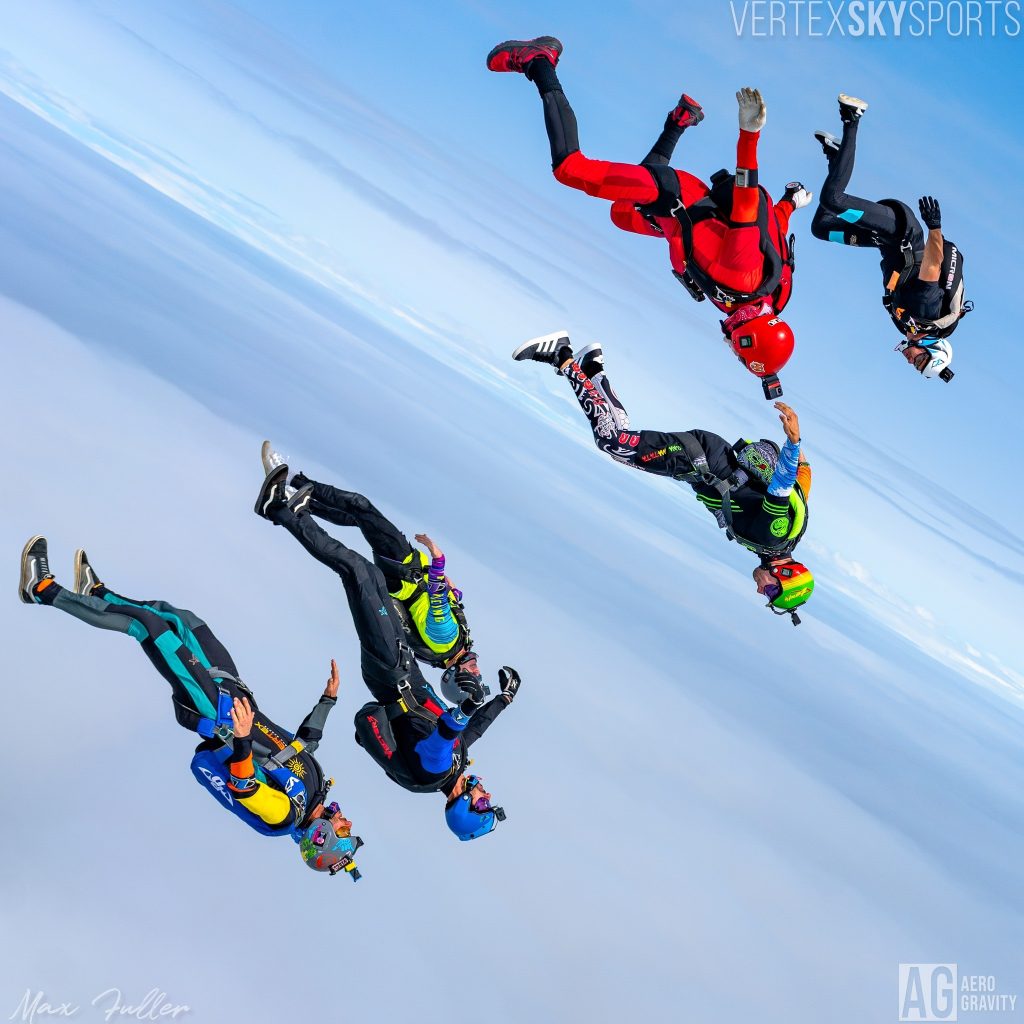
1. The group is being led by the skydiver in the green/yellow/red helmet. The group is tracking (body gliding) from the viewer’s left to right with a horizontal speed of about 50-60mph.
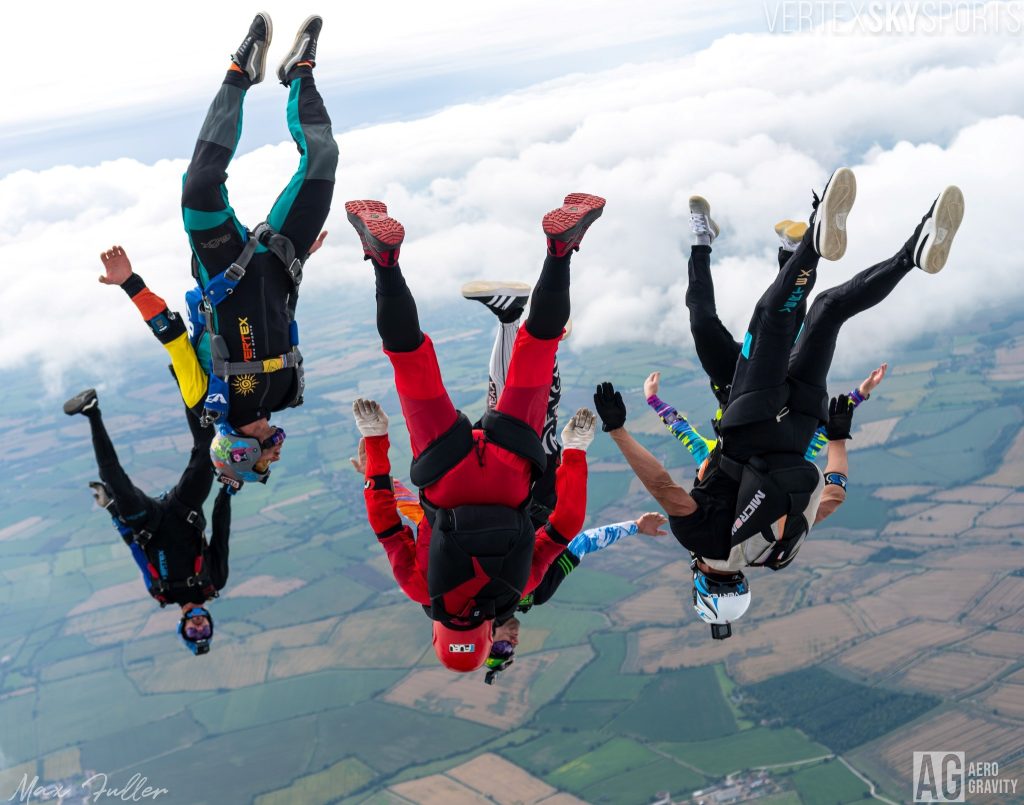
2. The group is in a vertical dive, accelerating to 150-200mph downwards. The leader has also rolled 180 degrees along his longitudinal axis to maintain visual with ground references.
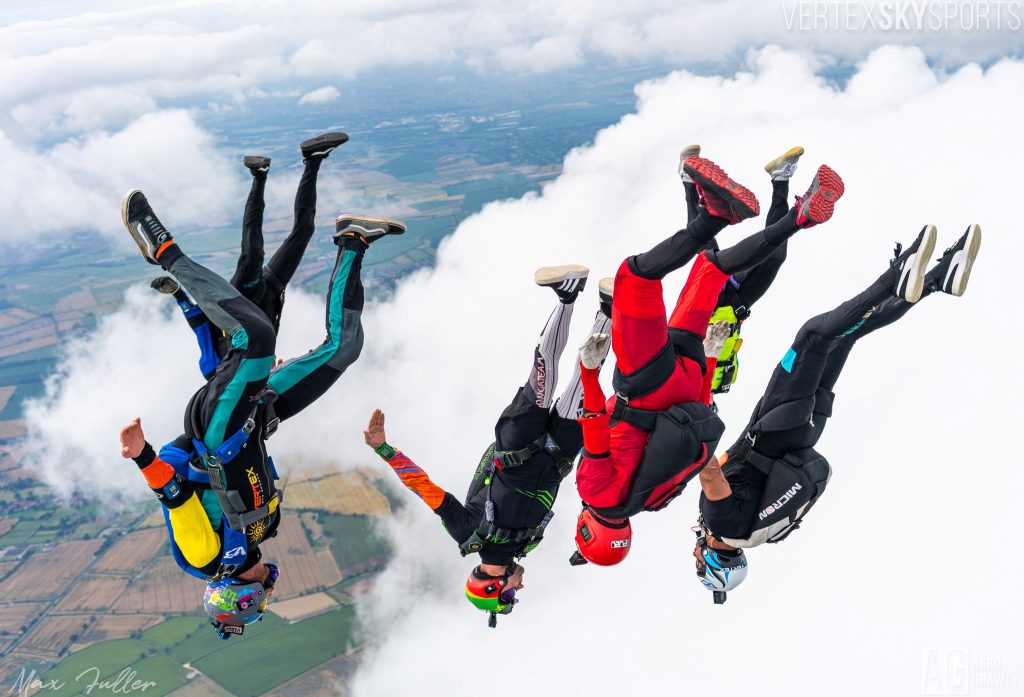
3. The group is now accelerating in the opposite horizontal direction (viewer’s right to left) and is having to control the large amount of kinetic energy.
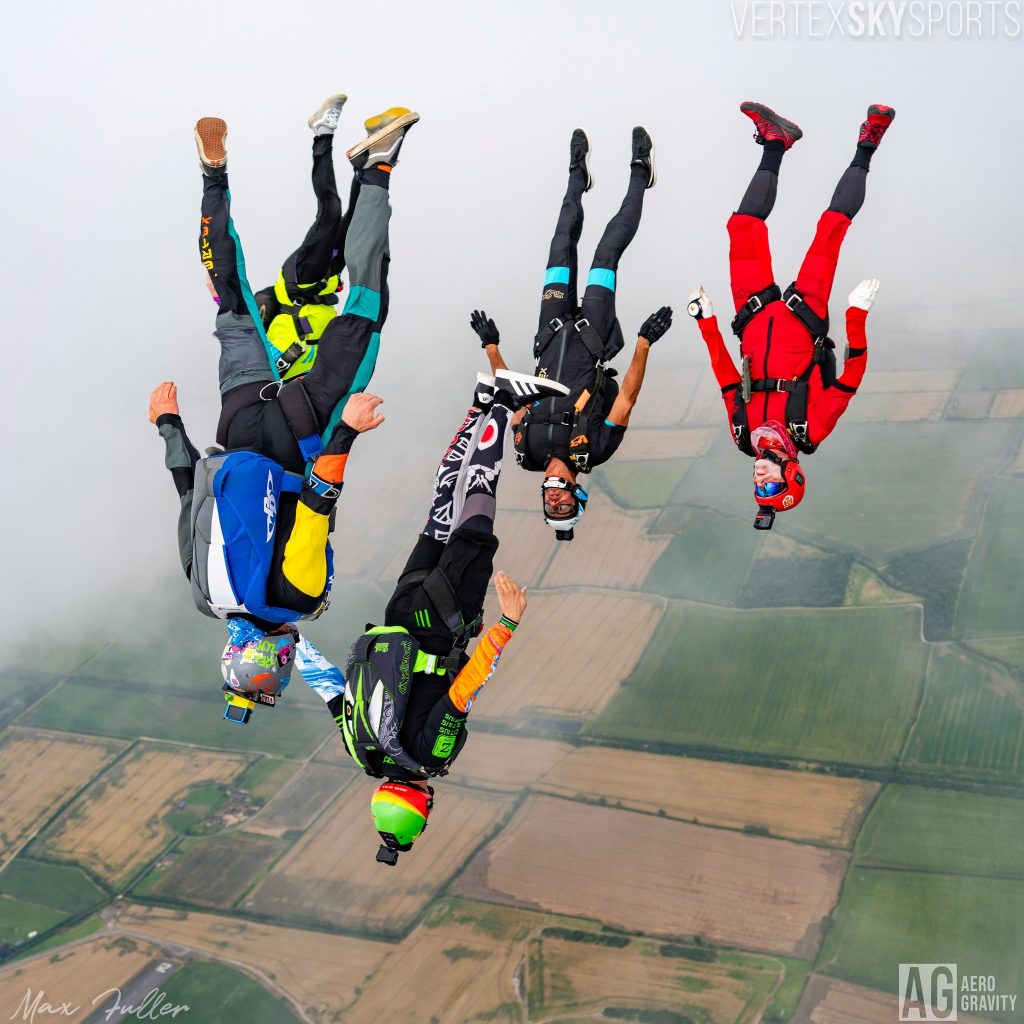
4. The group is flattening its trajectory to increase horizontal movement to about 60mph in the opposite direction to photo 1.
These photos were provided by the author, who was part of the formation and they explained that while the formation keeping was not perfect, it was a safe pass-through. Photos reproduced with kind permission.
Organisation
A group track may develop spontaneously, when the leader is usually responsible for fitting the plan to the people and for ensuring safety. At some pre-planned events, the event administrator may have an expectation that jumpers will go to the groups they are qualified for. A wise leader will recheck this at the start of the dive planning.
Some organised events require detailed written information from jumpers well in advance of the event and then allocate them to specific groups. It is common to require details of FF1/2 and TR1/2/3 but it would be unusual to see application forms asking for details of formal clearance to jump in larger groups.
Having a group size endorsement in a logbook may not always be easy to check, especially if written in a previous logbook or if an electronic logbook is being used. TR and FF qualifications are shown by stickers in the parachutist licence. Would there be benefit in having a “Plus” rating added to stickers, as with FS1 and FS1+ (e.g. FF2+ or TR3+)? This would keep the relevant information in one place and “sticker orientated” skydivers would have a clear target to aim for and a clear indication of what they are allowed to attempt.
A few questions may remain in some readers minds:
Why does someone without TR3 join a group for which FF2 & TR3 is required?
- Their usual skydiving friends may have been in that group, and they may have felt comfortable with them. It is OK to move down a group to be with friends, but not to move up a group.
- They may have done some jumps working towards TR3 and so believed they could hack it. In 1999, two psychologists (David Dunning & Justin Kruger) described how people learning a new skill would often overestimate their own ability to complete the task safely. This is known as the Dunning-Kruger effect.
- Fear Of Missing Out (FOMO) – the top group will be doing the best jumps
- Knowledge – they may not have been aware of the rules and may not have known that the group criteria were rule based not guidance based.
- “Because they can”. Qualifications and skill levels for licenced skydivers are commonly self-declared and not formally checked.
Why does someone, knowing they don’t have the required TR3 and knowing they only have small group experience, wait until just before boarding to confide to the leader alone that they have concerns? (still better then than never).
- Not wanting to admit they are in wrong group
- Not wanting to disappoint friends
- Delaying uncomfortable decisions is a common behaviour pattern in humans. This jumper did eventually discuss his qualification and experience level with the coach and is commended for doing so.
- Coaches commonly ask, “is there anyone not happy with the plan?” rather than “say if you are fully happy with this plan”. In a group, it is always easier to stay quiet than to raise a hand in front of others. We should positively praise jumpers who speak up and express concern.
Why does a coach proceed with a plan to pass through the vertical, when someone reports they have neither the qualification nor the prior experience for this move?
- With the props turning and fuel burning it is too late to rehearse a new plan and too late to pull off the load without losing the jump tickets. There are other groups also waiting to board the aircraft. Time pressure can easily result in suboptimal choices.
- Desire not to embarrass the non-TR3 jumper
- Desire not to disappoint the other jumpers who were looking forward to this high level jump
- The non-TR3 jumper may have performed satisfactorily on less demanding jumps earlier in the day and created an appearance of competence.
What other options may have been open to the coach in the boarding area?
- “Hey guys, we have to change the plan for safety reasons. Keep the same exit plan then follow me on a fast curvy cruise, but without a pass-through”
- “Skydiver X, you will have to do a solo vertical jump on this lift. Everyone else, we have the same dive plan but without Skydiver X”.
- It is easy to think of these “outs” at leisure after the event. A different matter to rapidly come up with one at the pressured time of boarding. It is good to have a rough Plan B ready for every skydive.
Key Issues relating to this report
-
GA1419
–
Initial Report
CHIRP Comment
Key Issues relating to this report
-
GA1421
–
Initial Report
CHIRP Comment
Key Issues relating to this report
-
GA1425
–
Initial Report
CHIRP Comment
Key Issues relating to this report
-
GA1423
–
Initial Report
CHIRP Comment
Key Issues relating to this report
The Airfield operator has informed CHIRP that at the time of writing no safety reports had been received from airfield users regarding the policy and therefore was curious why the reporter felt they would report to CHIRP first and not the airfield safety team. The airfield operator also said the policy was in place due to some specific operating requirements at the airfield which had been discussed at length to airfield users before the policy was promulgated, therefore although not optimal, it was a considered an operating necessity that is mitigated by discussion and raising awareness of the potential issues.