

Confidential Human Factors
Incident Reporting Programme


The Charity

Aviation

Maritime


The Charity
Aviation
Maritime
DUAS XX30

Initial Report
Note: this originated from AAIB report no 30757
Type of report: Accident
Aircraft Type and Registration: Phoenix Wings Orca
No & Type of Engines: 8 electric motors
Year of Manufacture: 2024 (Serial no: PW54)
Date & Time (UTC): 25 March 2025 at 1450 hrs
Location: Coombe Country Park, Warwickshire
Type of Flight: Commercial Operations (UAS)
Persons on Board: Crew – None; Passengers – None
Injuries: Crew – N/A Passengers – N/A
Nature of Damage: Damaged beyond economic repair
Commander’s Licence: Other
Commander’s Age: 23 years
Commander’s Flying Experience: 85 hours (of which 5 were on type)
Last 90 days – 16 hours
Last 28 days – 7 hours
Information Source: Aircraft Accident Report Form submitted by the Pilot.
Synopsis
The aircraft struck the ground in a wooded area whilst on approach to land at a site adjacent to Coventry Hospital. The accident occurred during the sixth consecutive flight, which was in preparation for demonstrating the aircraft being operated in accordance with the operator’s Beyond Visual Line of Sight with Visual Mitigations (BVLOS VM) authorisation. The cause of the accident was identified as a software bug in combination with a loss of synchronisation between the Remote Pilot (RP) and the Safety Remote Pilot (SRP), whereby the SRP’s hand controller had remained set to the disarm position when the aircraft had taken off. When the aircraft came within range of the SRP’s controller, this resulted in power being removed from the aircraft’s electric propulsion motors, leading to the aircraft stalling, its emergency parachute system being disabled, and subsequent uncontrolled descent from a height of 60m.
History of the flight
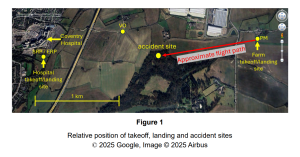
Several flights were being flown a total distance of about 1.5nm between a farm and a field adjacent to Coventry Hospital (Figure 1). These were being performed in preparation for a BVLOS VM demonstration flight.
The flight crew consisted of a Remote Pilot (RP), Safety Remote Pilot (SRP), Pad Manager (PM), Visual Observer (VO)¹ and an Emergency Response Team (ERP). The PM was located at the farm site and had a handheld controller that allowed the aircraft to take off and land. The SRP was at the hospital landing site and had a remote controller that provided the ability to take manual flight control of the aircraft, arm and disarm it and also terminate flight in the event of an emergency (refer to the aircraft information section for further detail). The RP was at the operator’s facility some miles away and was using a PC-based ground control station to control the aircraft, with the VO located about midway between the two sites and the ERP collocated with the SRP (Figure 1).
Coordination between the flight crew was made using two-way radios, with the control settings of the RP and SRP controllers being manually synchronised by each pilot, so that the aircraft was appropriately armed in preparation for flight and disarmed (shutdown) after each landing.
Five flights were successfully flown over the period of about an hour and, having completed the ground checks at the farm site, the aircraft took off to fly back to the hospital landing site. The aircraft climbed vertically to a height of about 50m AGL before transitioning to forward flight where it then climbed to its cruise height of 60m AGL. The aircraft’s take-off weight was 38.9kg.
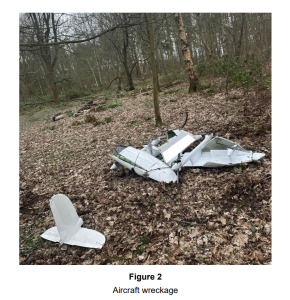
The aircraft was observed to follow the planned flight profile but as it approached approximately the halfway point the aircraft’s motors suddenly stopped. The aircraft initially maintained altitude but subsequently stalled, before descending quickly and striking the ground within a wooded area (Figure 2). No persons were injured and there was no damage to property; the aircraft was damaged beyond repair.
The RP, SRP and PM reported that they had not made any selections on their respective controllers in the period before the aircraft departed from controlled flight.
Footnote
¹ The VO is a designated person who assists the pilot during BVLOS flights. The VO’s primary responsibility is to maintain visual contact with the aircraft and its surroundings, alerting the remote pilot who may not be able to observe the aircraft to any potential hazards or conflicts. The VO provides the visual mitigations required by the BVLOS VM authorisation.
Accident site
The aircraft struck the ground in a wooded area (Figure 2) which was accessible to the public. Approximately 250m from the accident site was an outdoor activity centre.
Analysis
When the aircraft took off from the hospital site during the fifth flight, the SRP controller’s arm/disarm switch was in the arm position. In accordance with the operator’s procedures it should then have been set to the disarm position when the aircraft landed and set back to the arm position prior to take-off. However, the recorded data showed that as the aircraft approached the hospital landing site, and communication with the SRP controller was established, the controller was recorded as being in the disarm position. The SRP reported that he had not moved this switch during the flight. It is therefore most likely that the selection was synchronised correctly with the RP after the aircraft had landed at the farm, but a loss of synchronisation with the RP then occurred, with the selection remaining in the disarm position when the aircraft took off.
The checklist used by the RP and SRP did not include a formal verification (check and challenge) of the arm/disarm switch selection. This increased the possibility that a loss of synchronisation between the two remote pilots was not detected and this risk may have been further increased by conducting several flights in relatively quick succession.