GA1402 - Paraglider and light aircraft in close proximity
Initial Report
I am a paraglider pilot. I was flying in good conditions and was trying to gain height above fields at the southern edge of [Location]. I was low and circling slowly in very weak lift. My net ground speed would have been approximately 10 km/h (I was circling slowly and drifting in an approx. 20 km/h wind). Visibility was excellent, with bright sunlight. My wing is bright blue with lime green and pink markings. My helmet is bright orange and my jacket bright blue. On one of my turns, I observed a white and blue single-engine aircraft directly in front of me and within a few seconds flight in terms of distance and heading. I was north of the light aircraft and would have been highly visible given light direction and colours.
I immediately broke out of my turn pattern: I was turning right and continuing would have given significant risk of a mid-air collision on my next turn given my assessment of course and speed.
On my left turn I could see the aircraft at the same height now passing very close by. I did not observe any deviation from course by Piper. I have a FLARM device and was in addition visible on both Open Glider Network (OGN) and PureTrack. I have been shown the PureTrack record by another pilot showing the intersecting trajectories, proximity and heights. [At closest point] I was about 200m away and 48 feet below the Piper. My view on the tracklogs is that a collision was quite likely had I not seen the Piper and immediately deviated from my path. I did wonder if there would have been opportunity see the Piper earlier, but it is hard to see how. Given the speed of the [light aircraft concerned], the low visibility of a small aircraft viewed straight on from the front, the white and blue colour and the fact that they were coming from the S or SSW on a bright day, I am not sure this is realistic.
I felt suitably ‘on the ball’ in terms of awareness of airspace. I had been comfortably flying in proximity to sailplanes at several points in the long flight: they are harder to spot, it is necessary to be very ‘switched on’ to small aircraft on such a flight, and I was also aware of a small helicopter lower down also close to [my location].
I wondered whether the [light aircraft pilot] had been able to see me and whether there are additional practical measures to improve visibility if bright colours, FLARM and trackers aren’t effective.
CHIRP Comment
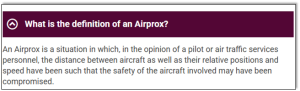
This report was of great interest to CHIRP as it highlights the ever-present hazard in GA airspace of aircraft airprox events, such as described here by the paraglider pilot.
Of note is that, despite this being an AIRPROX event, the paraglider pilot chose to report to CHIRP and not to the UK Airprox Board (UKAB). The UKAB provides a vital air safety function and CHIRP recommends that all incidents such as this, where a pilot believes safe separation with another air user was compromised are sent firstly to UKAB, and then also to CHIRP if the reporter wishes to do so, particularly if human factors considerations, as is usually the case, were a contributing factor. CHIRP does not have the dedicated resource to investigate loss of safe separation events as does the UKAB, which can utilise many more data sources, such as independent radar traces etc, to corroborate accounts.
From a human factors perspective, the paraglider pilot’s situational awareness and good lookout appear to have averted a very close pass between the two airspace users in accordance with the account provided. Not knowing the situation, as experienced from the light aircraft, means we cannot comment further other than to re-emphasise the importance that all pilots develop and practice a formalised, habitual, look out scan, which includes use of any fitted EC equipment as part of that scan, to improve likelihood of early sighting of other aircraft – including balloons & hang gliders – that are on a steady, collision course with their own aircraft, and in good time to take avoiding action.
Key Issues relating to this report
Human Factors Considerations
The following ‘Dirty Dozen’ and Human Factors were a key part of the CHIRP discussions about this report.
Positive HF elements:
- Safety/learning culture – proactive self-reporting of a flight safety event
- Procedural discipline – situational awareness and look out prioritised
- Composure under pressure – calm handling of the paraglider following unexpected loss of safe separation with another aircraft