DUAS 0039 - Pilot Error causes DJI Mini 5 to crash into fine tree branches
Initial Report
Incident Description (Pilot Report)
- Location: Gorge at XXXXX, over the XXXX.
- Conditions: Calm weather, no high wind or rain. GPS signal was weak due to the steep-sided location.
- Flight Profile: Low-altitude aerial tracking along the river, navigating between overhanging tree branches.
What Happened
- While conducting the low-level pass, the drone entered an area with multiple fine overhanging branches.
- The pilot briefly focused on the screen to maintain positioning.
- Although most branches were avoided, one fine branch was not detected by the drone’s obstacle avoidance system.
- The drone became entangled in the branches above deep water.
- Due to the height, river conditions, and risk to safety, recovery was not possible. The aircraft was deemed unrecoverable and is considered a total loss.
Contributing Factors
- Weak GPS signal in the gorge.
- Fine branches not detected by obstacle avoidance sensors.
- Pilot over-reliance on obstacle avoidance capability in a high-risk environment.
- Low-altitude proximity to natural obstructions.
Safety Outcome
- No persons were present nearby.
- No property damage other than the aircraft.
- Aircraft written off in situ.
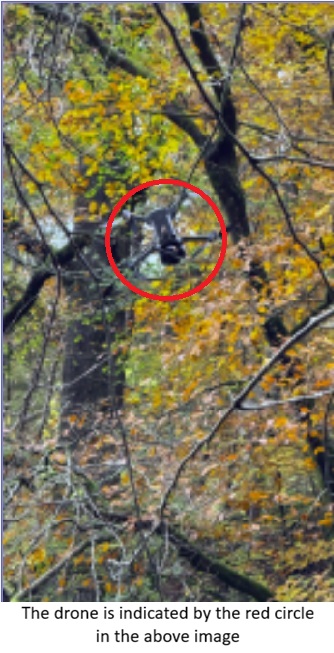
CHIRP Comment
The Board had the following comments:
- When flying in this sort of scenario, it is wise to have tested the Drone proximity detection capabilities beforehand. In doing so you will refresh your sense of the limitations of the aircraft’s obstacle avoidance capabilities.
- Although they have evolved substantially, proximity detection systems do have a limit, and very thin branches or wires with a grey background can catch pilots out. In the winter with no leaves on them, they are difficult enough to see with the naked eye. It will of course partly depend on the background.
- Depending on the type of Drone, the built-in systems do have an angle where there is a blind spot for detection. This also needs to be considered.
- If the level of light is low, the detection system will be even less effective at “seeing” thin branches.
- Visual Line of Sight (VLOS) should be treated as the primary method for deconfliction. Obstacle Avoidance sensors should serve as a backup method. We wonder whether framing the shot became too much of a focus of attention.
- There is no substitute for a pre-flight site assessment of the route to be flown before deciding to take off. In this instance it is not clear that an assessment was done, which if it had been may helped with depth and distance perception and avoiding branches.