GA1417 - 'Near collision during complex sky diving serial'
Initial Report
Report text (summarised from original highly technical report):
Parachute Jump type: Complex group “free flying” and “tracking”, requiring Tracking Grade 3 (TR3) and Free fly Grade 2 (FF2) qualifications – see CHIRP comment below for explanation of free flying, tracking, and relevant qualifications needed.
Group experience:
The assumption was that all jumpers had the necessary qualification via communication during the brief, and all jumpers expressed happiness with the jump plan. New information was then received on one individual, just as the group was embarking jump aircraft. It transpired this person actually only had limited experience of the jump serial, in smaller groups, and most importantly did not have the necessary qualification (TR3).
Coach’s thoughts:
I felt irritation and did not want to change the plan as we had thoroughly briefed the plan and did not want to disappoint the rest of the group who were qualified for this and had practiced well.
Jump description:
During the jump the less qualified individual moved out of slot and did not react efficiently to the transition and couldn’t cope with the situation in a safe way and kept following without maintaining visual reference with the leader. All flyers behind me had presumed I had started the move as I had keyed it but due to my attention moving to the non-qualified individual, I paused on the transition which started the cycle of mistakes. As I started a pass-through transition the timing difference between myself and the other flyers caused a high-speed fly past by 2 of them, one passed by within a meter at a speed which would have been fatal if contact had been made.
CHIRP Comment
This was a very serious “near miss”. CHIRP congratulates the reporter – the coach concerned – for contacting CHIRP, for identifying some of the causative factors, and for giving an insightful and honest account of their own contribution. The report highlights why regulations around qualifications, and experience levels are in place even for licenced skydivers. Adhering to them would almost certainly have prevented what must have been a frightening experience for some of the group.
FF2 is the higher free fly qualification which entitles jumpers to fall head down vertically in groups with other free flyers.
TR1/2/3 are the qualifications that allow free fallers to fly in groups while also gliding horizontally at speeds of up to 80mph (this is called ‘Tracking’).
TR3 is the highest of these grades and allows jumpers to participate in the steepest, fastest angles where there is greatest potential for rapid acceleration or deceleration.
Coaches should feel confident in making safety calls, even at the last moment, and should be supported by the skydivers. Better to disappoint by stopping a jump than to disappoint by having a serious or fatal injury. Many multigroup events have an appropriate focus on “Fun” but this should never trump safety.
Additional Information for those who are not familiar with sky diving and want to better understand the operating context.
A ‘steep tracking dive’ involves reversing direction by a pass through the vertical, involves everyone following a single leader, with the belly trackers gradually transitioning through the vertical (head down) to back tracking and the back trackers gradually transitioning through the vertical (head down) to belly tracking. It is one of the more demanding types of tracking jump and requires all jumpers to be able to keep the same station with the leader, regardless of whether the leader’s transitions are smooth and progressive, staggered or even paused completely. The pass-through transition from back to belly track is well known for suddenly unlocking a huge amount of lift and acceleration. It is not always easy for less experienced jumpers to control this – a pause by the leader can result in sudden and large separation of some followers, who may then strive to regain proximity at high speed. When the leader then resumes their transition to accelerate on their belly, the closing speed between the returning follower and leader can suddenly become so great that the follower is unable to avoid a high speed fly past or a collision. The leader does not have eyes in the back of their head and so, regardless of the leader starting on their back or their belly, anything other than a smooth transition by the leader and rock steady station keeping by the followers will carry some risk of traffic problems or collisions.
‘Pass-throughs’ are normally learned initially by one-on-one coaching. This allows a safer environment for learning errors. As the group size increases, situational awareness is essential and even small failures in station keeping can cause complex traffic problems. The British Skydiving Operations manual specifically limits maximum group size to 4 persons when one of them is training for TR3. Even after TR3 is obtained, the Ops Manual restricts group size for steep tracking groups to 6 persons, unless each person has been cleared for jumping in larger groups by an Advanced Instructor (normally demonstrated by an entry in the skydiver’s logbook). It is exceptional to hear a group leader or coach asking jumpers about their group size clearance and one has to question how effectively this well intentioned and sensible regulation is being applied or checked.
The following images illustrate a pass-through manoeuvre:
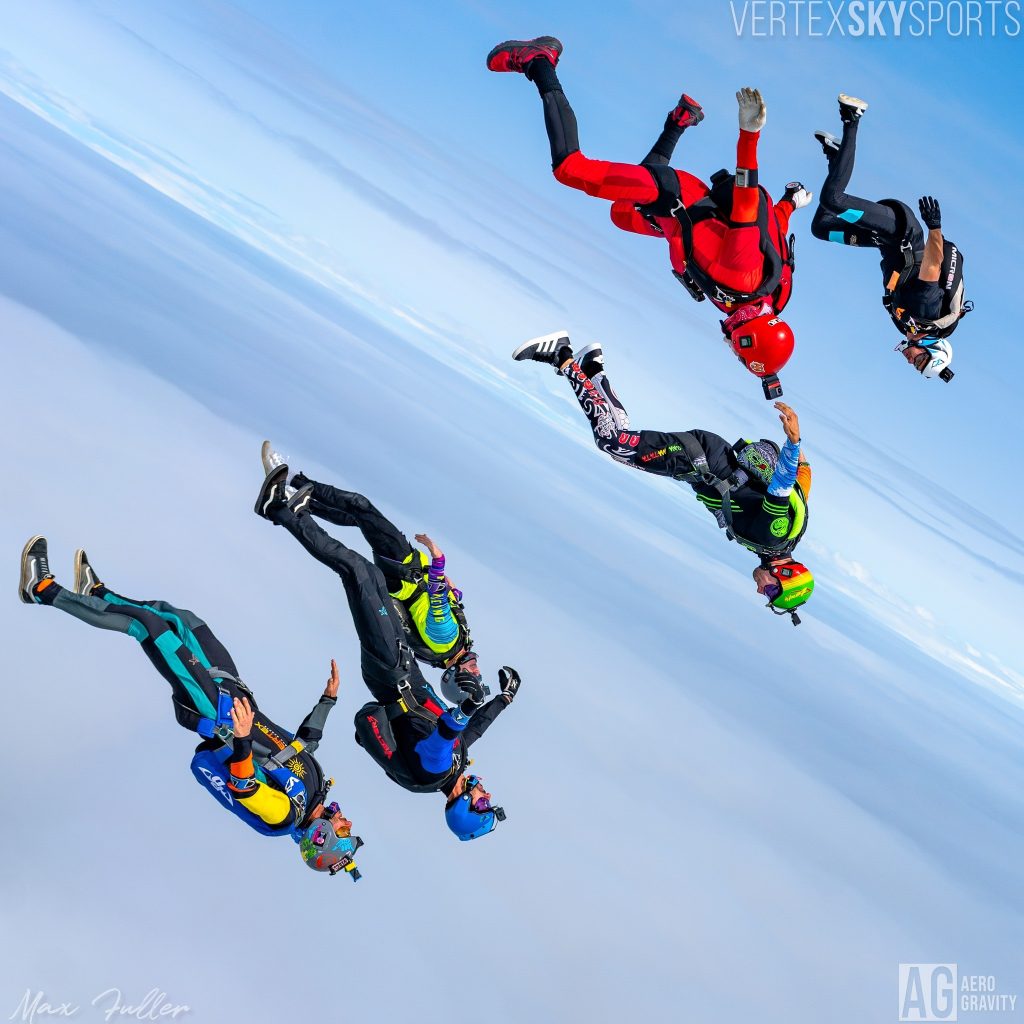
1. The group is being led by the skydiver in the green/yellow/red helmet. The group is tracking (body gliding) from the viewer’s left to right with a horizontal speed of about 50-60mph.
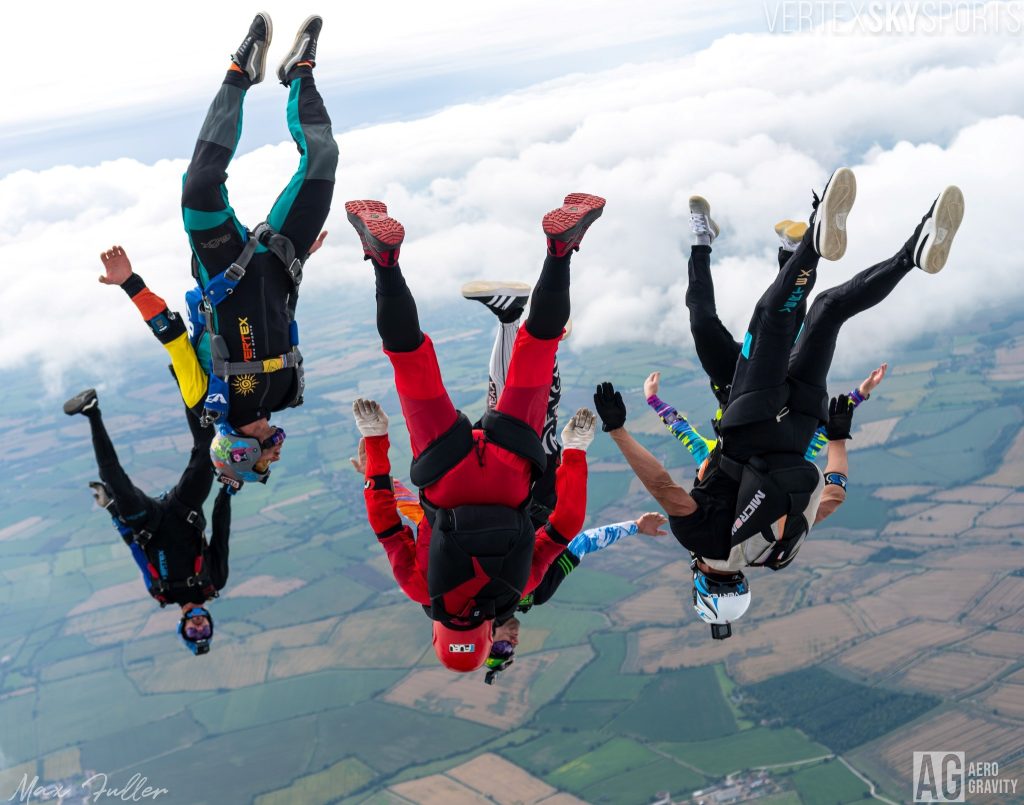
2. The group is in a vertical dive, accelerating to 150-200mph downwards. The leader has also rolled 180 degrees along his longitudinal axis to maintain visual with ground references.
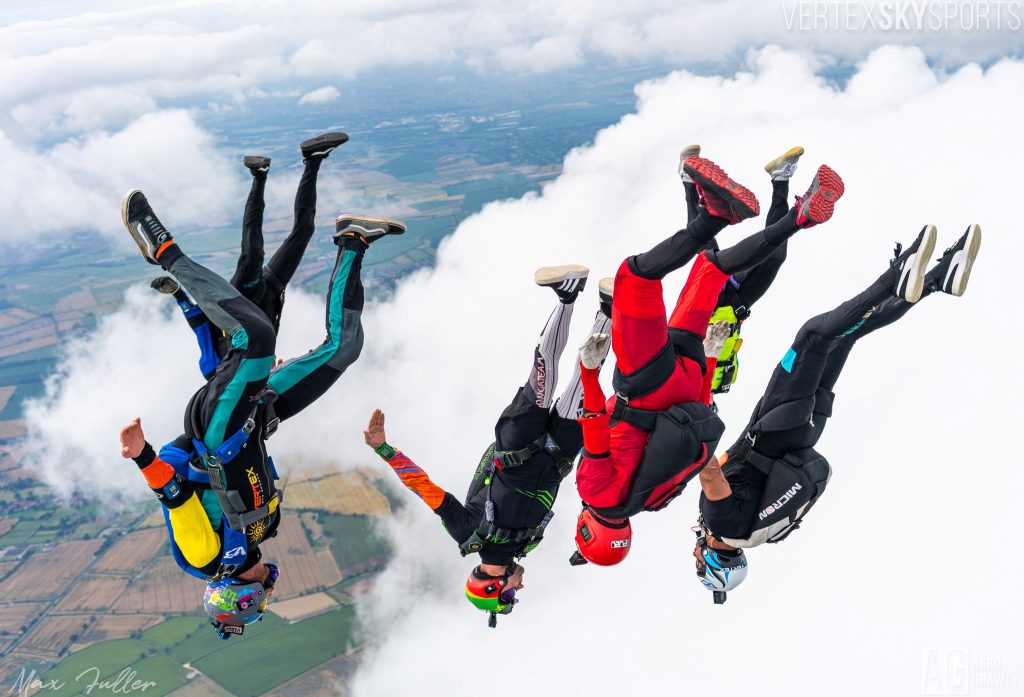
3. The group is now accelerating in the opposite horizontal direction (viewer’s right to left) and is having to control the large amount of kinetic energy.
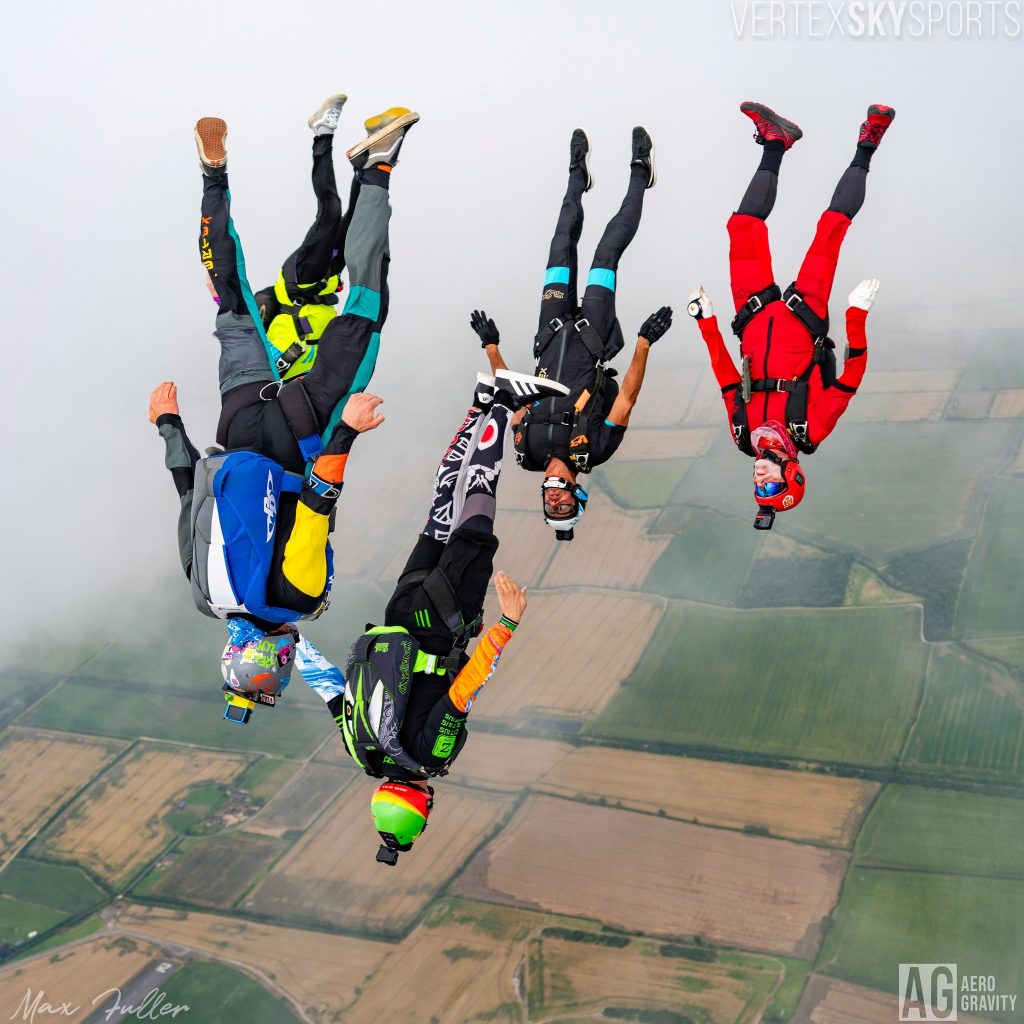
4. The group is flattening its trajectory to increase horizontal movement to about 60mph in the opposite direction to photo 1.
These photos were provided by the author, who was part of the formation and they explained that while the formation keeping was not perfect, it was a safe pass-through. Photos reproduced with kind permission.
Organisation
A group track may develop spontaneously, when the leader is usually responsible for fitting the plan to the people and for ensuring safety. At some pre-planned events, the event administrator may have an expectation that jumpers will go to the groups they are qualified for. A wise leader will recheck this at the start of the dive planning.
Some organised events require detailed written information from jumpers well in advance of the event and then allocate them to specific groups. It is common to require details of FF1/2 and TR1/2/3 but it would be unusual to see application forms asking for details of formal clearance to jump in larger groups.
Having a group size endorsement in a logbook may not always be easy to check, especially if written in a previous logbook or if an electronic logbook is being used. TR and FF qualifications are shown by stickers in the parachutist licence. Would there be benefit in having a “Plus” rating added to stickers, as with FS1 and FS1+ (e.g. FF2+ or TR3+)? This would keep the relevant information in one place and “sticker orientated” skydivers would have a clear target to aim for and a clear indication of what they are allowed to attempt.
A few questions may remain in some readers minds:
Why does someone without TR3 join a group for which FF2 & TR3 is required?
- Their usual skydiving friends may have been in that group, and they may have felt comfortable with them. It is OK to move down a group to be with friends, but not to move up a group.
- They may have done some jumps working towards TR3 and so believed they could hack it. In 1999, two psychologists (David Dunning & Justin Kruger) described how people learning a new skill would often overestimate their own ability to complete the task safely. This is known as the Dunning-Kruger effect.
- Fear Of Missing Out (FOMO) – the top group will be doing the best jumps
- Knowledge – they may not have been aware of the rules and may not have known that the group criteria were rule based not guidance based.
- “Because they can”. Qualifications and skill levels for licenced skydivers are commonly self-declared and not formally checked.
Why does someone, knowing they don’t have the required TR3 and knowing they only have small group experience, wait until just before boarding to confide to the leader alone that they have concerns? (still better then than never).
- Not wanting to admit they are in wrong group
- Not wanting to disappoint friends
- Delaying uncomfortable decisions is a common behaviour pattern in humans. This jumper did eventually discuss his qualification and experience level with the coach and is commended for doing so.
- Coaches commonly ask, “is there anyone not happy with the plan?” rather than “say if you are fully happy with this plan”. In a group, it is always easier to stay quiet than to raise a hand in front of others. We should positively praise jumpers who speak up and express concern.
Why does a coach proceed with a plan to pass through the vertical, when someone reports they have neither the qualification nor the prior experience for this move?
- With the props turning and fuel burning it is too late to rehearse a new plan and too late to pull off the load without losing the jump tickets. There are other groups also waiting to board the aircraft. Time pressure can easily result in suboptimal choices.
- Desire not to embarrass the non-TR3 jumper
- Desire not to disappoint the other jumpers who were looking forward to this high level jump
- The non-TR3 jumper may have performed satisfactorily on less demanding jumps earlier in the day and created an appearance of competence.
What other options may have been open to the coach in the boarding area?
- “Hey guys, we have to change the plan for safety reasons. Keep the same exit plan then follow me on a fast curvy cruise, but without a pass-through”
- “Skydiver X, you will have to do a solo vertical jump on this lift. Everyone else, we have the same dive plan but without Skydiver X”.
- It is easy to think of these “outs” at leisure after the event. A different matter to rapidly come up with one at the pressured time of boarding. It is good to have a rough Plan B ready for every skydive.
Key Issues relating to this report
Possible Human factors considerations that could contribute to such an event:
- Overconfidence – the Dunning-Kruger effect whereby humans overestimate their abilities when inexperienced. The individual concerned believed they had the skill and ability to make the jump.
- Communication – qualifications and experience not reported or sought until about to board aircraft for jump.
- Knowledge – did the jumpers know the TR3 requirement was a rule, not just guidance?
- Pressure of time/cost – Jump aircraft propellors turning.
- Pressure from peers – desire not to disappoint.
- And finally, F.O.M.O. – maybe not one of the conventional ‘Dirty Dozen’ Human Factors but not an uncommon skydiver trait, CHIRP has been reliably told!